
Autism is a lifelong developmental difference that shapes how a person perceives the world and interacts with others. It is not an illness or a disease; it is a fundamental part of an individual’s identity.
The Spectrum Concept
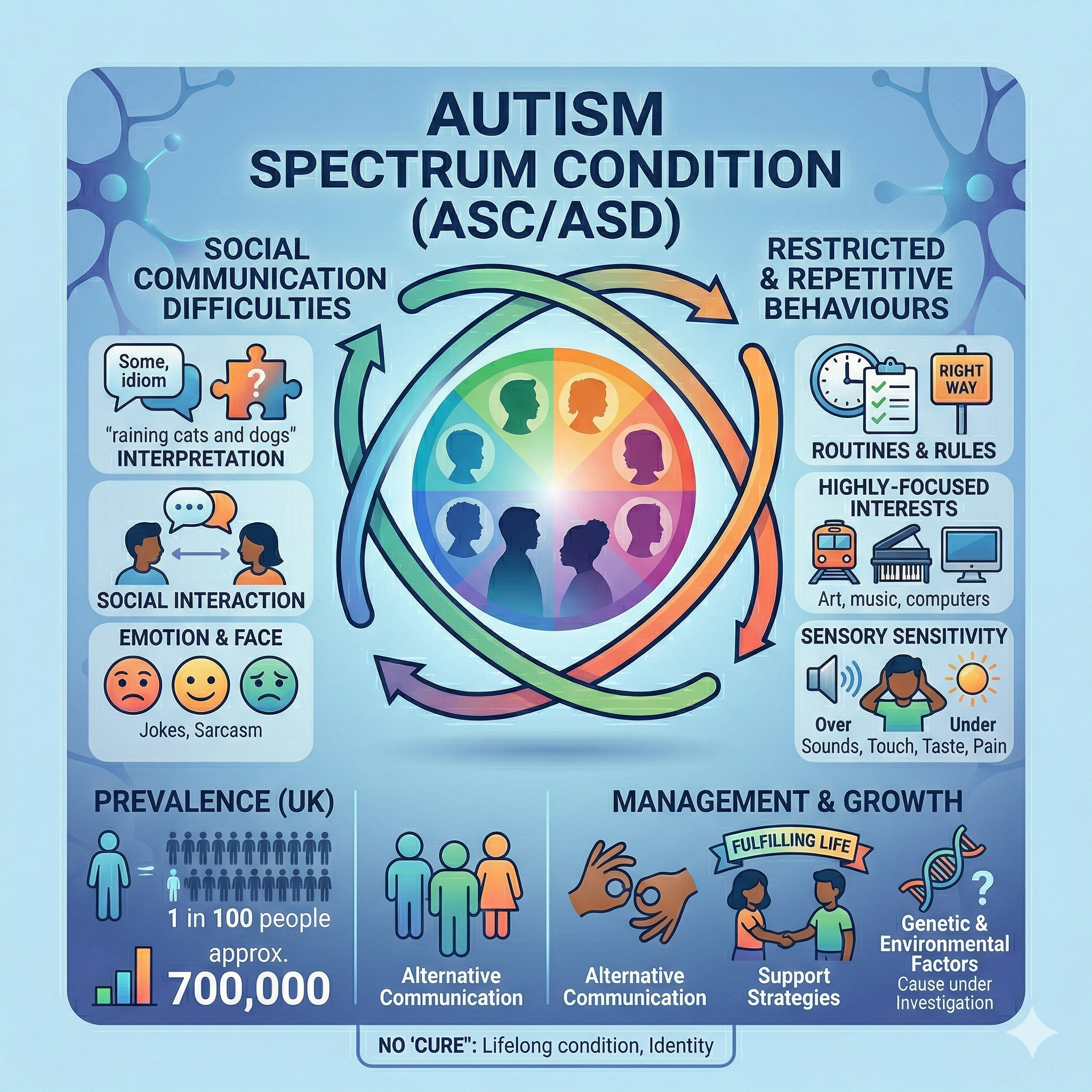
Autism is a spectrum. This doesn’t mean it’s a linear line from “mild” to “severe,” but rather a circular profile where individuals have varying strengths and challenges in different areas, such as sensory processing, motor skills, or communication.
- Prevalence: Roughly 1 in 100 people in the UK are autistic (approx. 700,000 people).
- Demographics: It affects people of all backgrounds, though it is currently diagnosed more frequently in men than women.
Core Characteristics of Autism
For a formal diagnosis, professionals look for persistent differences in two main areas:
1. Social Communication & Interaction
Autistic individuals process verbal and non-verbal language differently.
- Literal Interpretation: Many take language literally, finding jokes, sarcasm, or “vague” instructions difficult to parse.
- Non-Verbal Cues: Reading facial expressions or “tone of voice” can be challenging.
- Social Reciprocity: Navigating the “unwritten rules” of social interaction can feel overwhelming. Some may prefer solitude to avoid social exhaustion (burnout).
2. Restricted & Repetitive Patterns
- Predictability: The world can feel chaotic. Routines and “rules” provide a sense of safety and order.
- Focused Interests: Many autistic people have intense, highly-focused interests. These are often a source of great joy, expertise, and well-being.
- Sensory Processing: Autistic people may be hypersensitive (over-sensitive) or hyposensitive (under-sensitive) to light, sound, smell, or touch.
Diagnosis: Why It Matters
A diagnosis is a formal identification usually made by a multi-disciplinary team (speech therapists, paediatricians, and psychologists).
The Benefits include:
- Self-Understanding: Helping the individual understand why they experience the world differently.
- Access to Support: Unlocking rights to workplace adjustments, educational support, and specialized services.
- Community: Connecting with others who share similar experiences.
Causes and Support
- What causes it? Research suggests a combination of genetic and environmental factors. It is not caused by upbringing or social circumstances.
- Is there a “cure”? No. Because autism is a neurological difference, it does not need a “cure.”
- The Goal: Support is focused on enabling learning, managing sensory environments, and helping individuals live fulfilling lives on their own terms.
Key Takeaway: With the right environment and understanding, autistic people can thrive. Clear communication and sensory-friendly spaces make the world more accessible for everyone.